
Research
Fully Implicit Runge–Kutta Methods for Time-Dependent PDEs
Fully implicit Runge–Kutta (FIRK) methods offer high-order temporal accuracy and favorable stability properties, but their coupled stages lead to large nonlinear systems. This research develops multigrid and block preconditioners that make these methods practical for time-dependent flow problems.
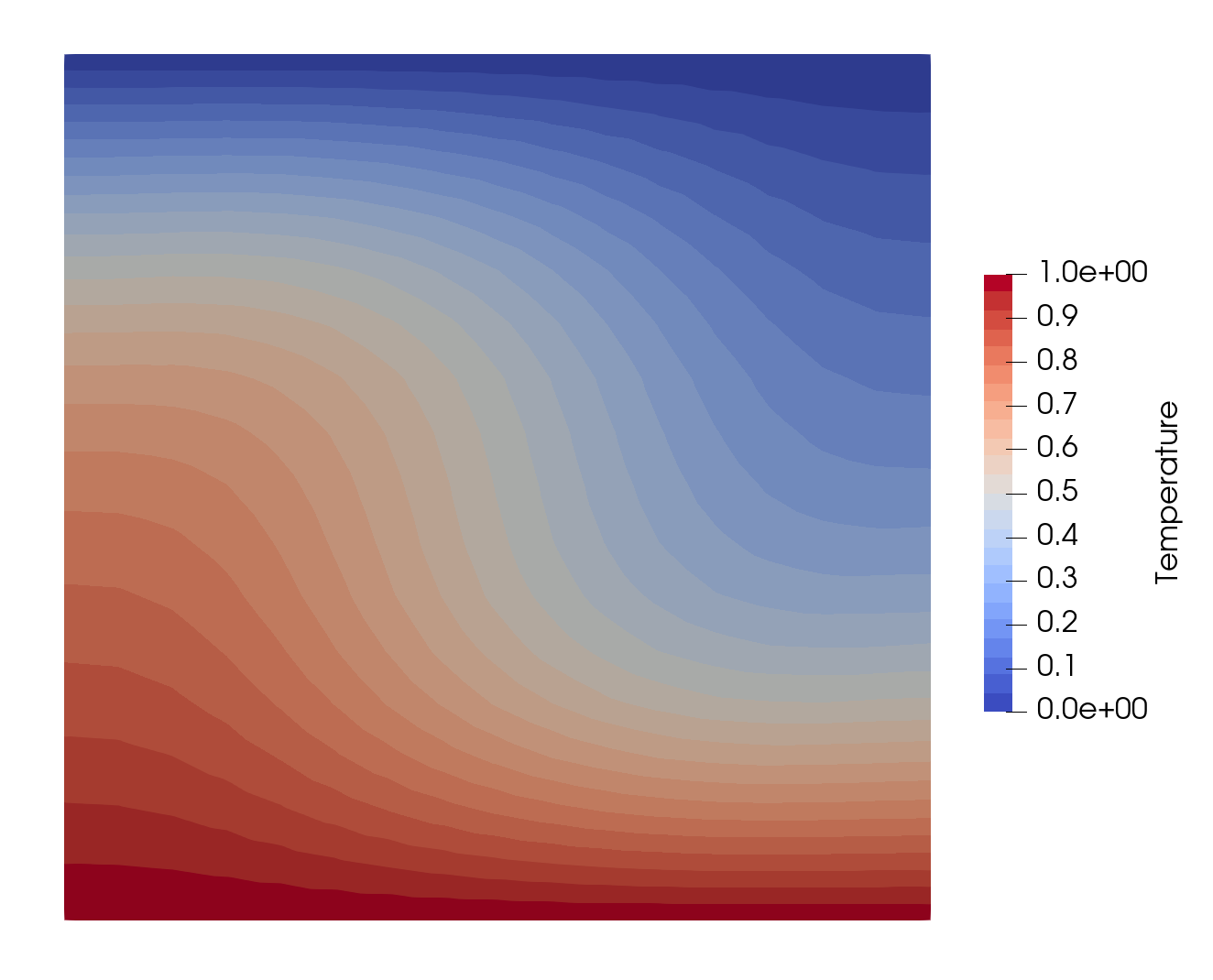
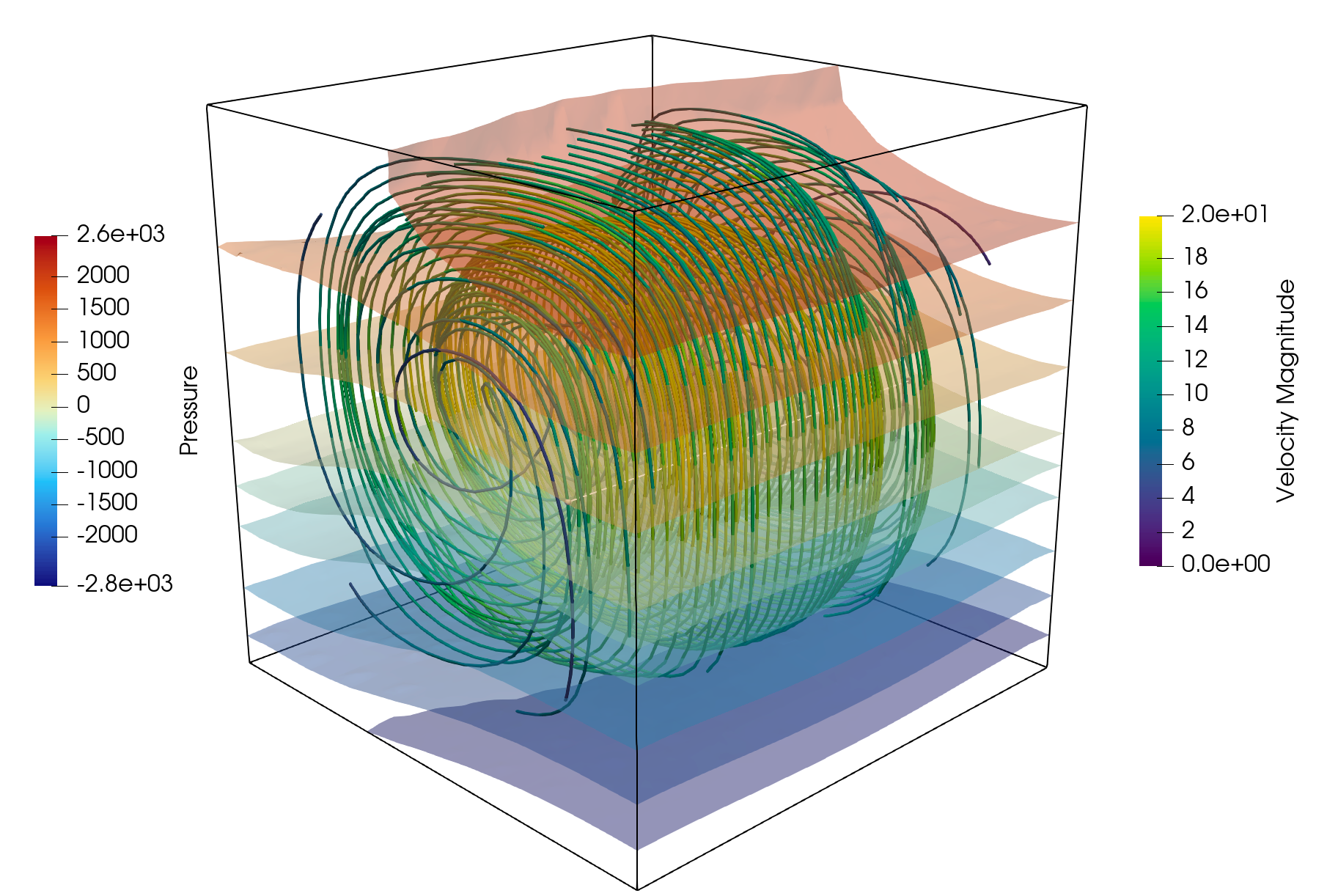
Recent work focuses on Rayleigh–Bénard convection governed by the incompressible Boussinesq equations. It combines Radau IIA methods with mixed finite element discretizations and investigates two solver strategies: augmented Lagrangian block preconditioning and monolithic multigrid with Vanka relaxation. Numerical experiments examine solver performance in two and three dimensions, including stage dependence and parallel scalability.
Recent preprint: Scalable Fully Implicit Runge–Kutta Solvers for Time-Dependent Rayleigh–Bénard Convection (2026; submitted for publication).
Algebraic Multigrid for Nonsymmetric and Indefinite Problems
Optimal Transfer Operators and Convergence Theory
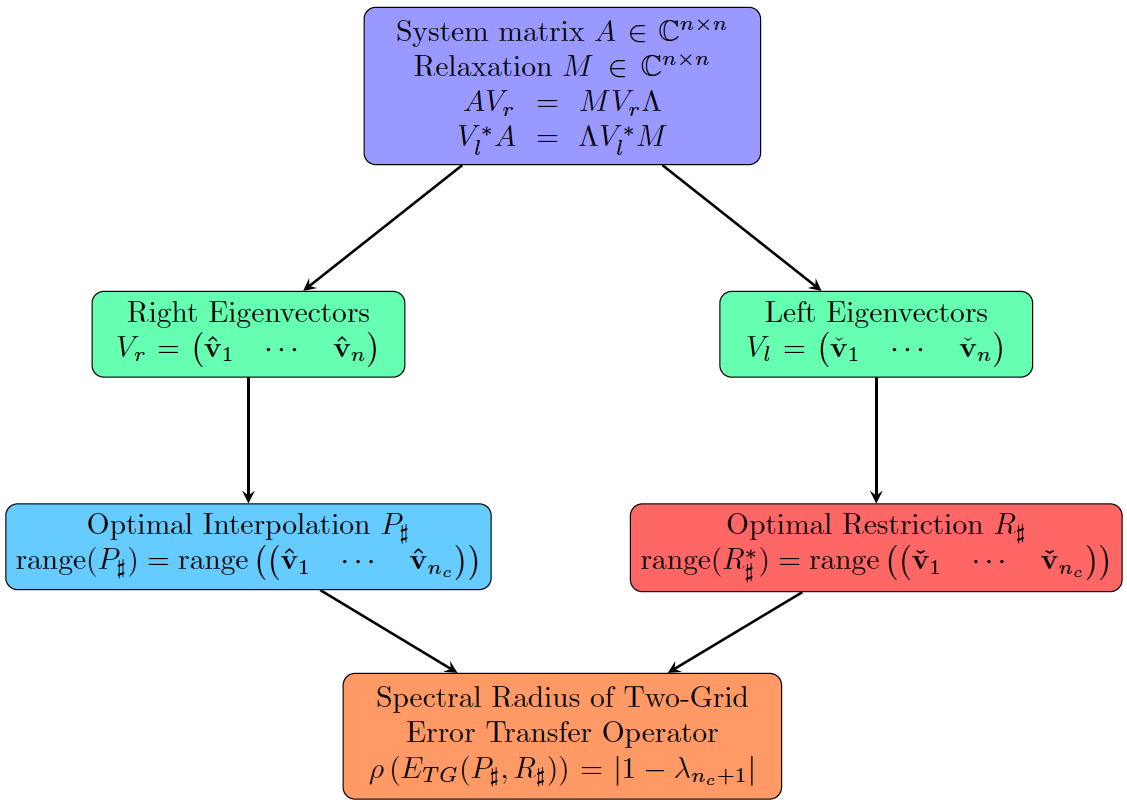
For nonsymmetric linear systems, the choice of restriction and interpolation strongly affects multigrid convergence. This line of work studies optimal two-level methods, sharp convergence bounds, and the role of left and right spectral information in constructing coarse spaces. The aim is to connect rigorous convergence theory with algorithms that remain effective beyond the symmetric positive definite setting.
Related research: Optimal Transfer Operators in Algebraic Two-Level Methods for Nonsymmetric and Indefinite Problems, SIAM Journal on Matrix Analysis and Applications (2026), and Generalized optimal AMG convergence theory, SIAM Journal on Scientific Computing (2025).
Reduction-Based Algebraic Multigrid
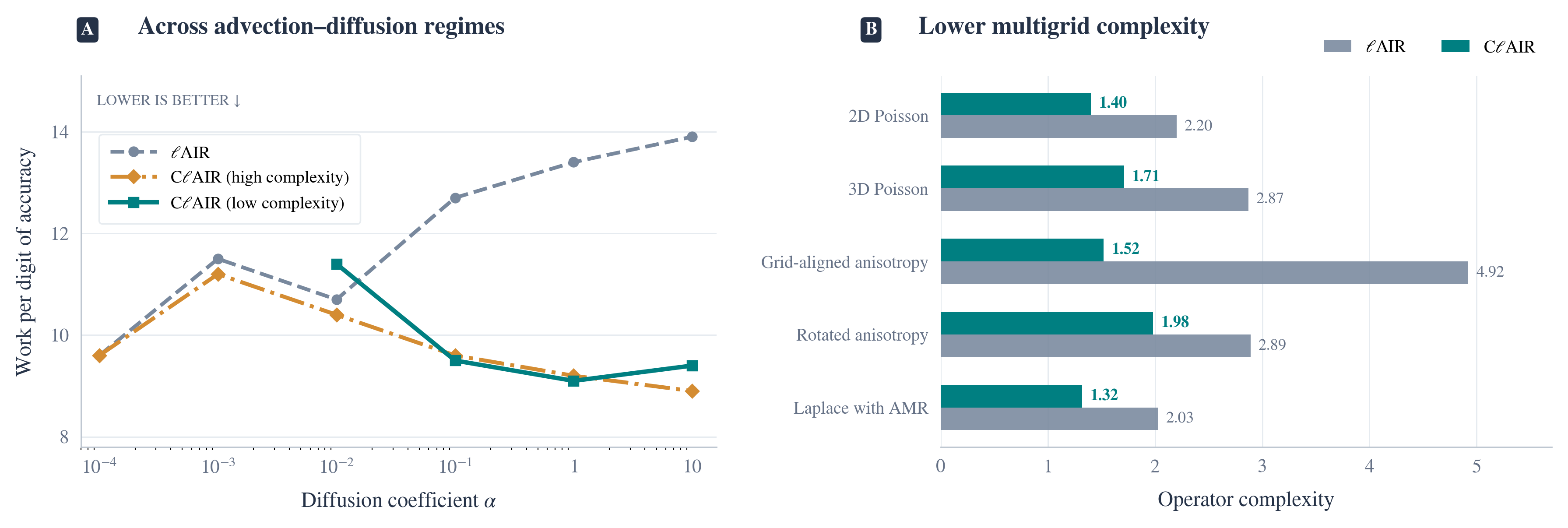
The constrained local approximate ideal restriction (CℓAIR) approach develops local approximations to ideal restriction while enforcing constraints associated with important error modes. This provides an algebraic multigrid strategy for problems in which nonsymmetry and strong advection make conventional approaches challenging.
Related research: CℓAIR, SIAM Journal on Scientific Computing (2024).
Scalable Solvers for Kinetic Plasma Models
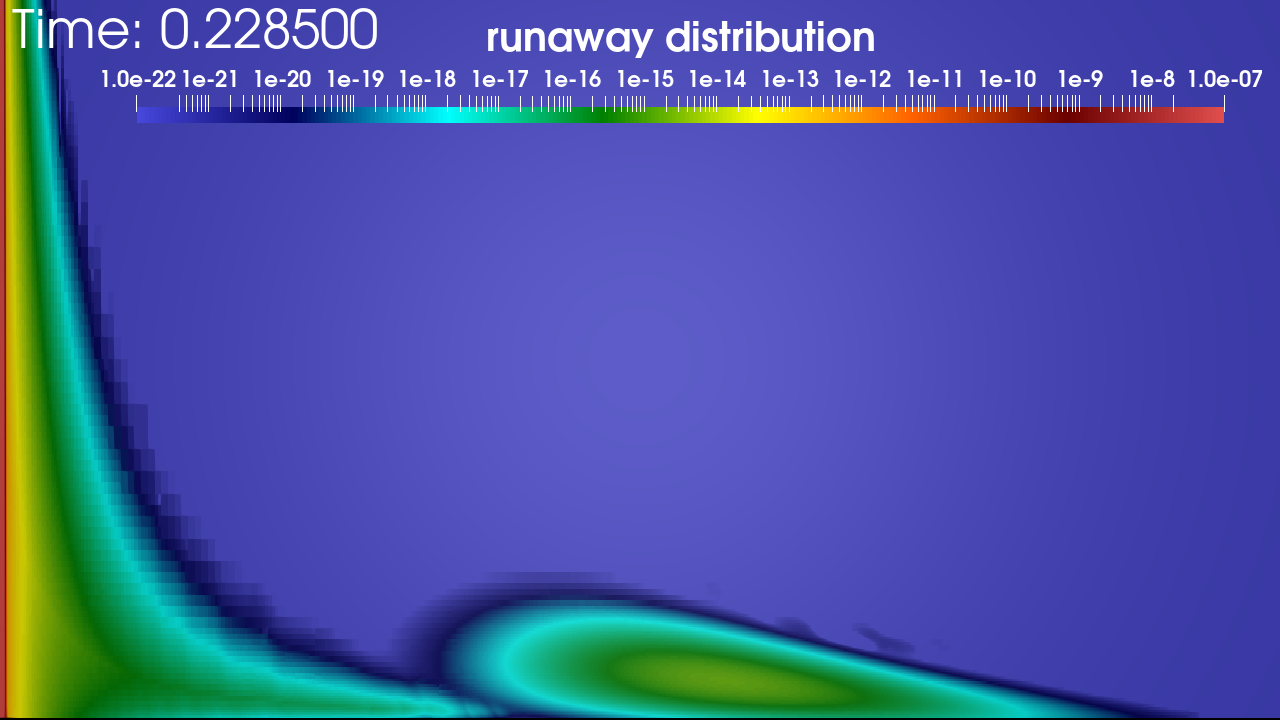
Earlier collaborative work with Los Alamos National Laboratory applied reduction-based multigrid to systems arising from a relativistic drift-kinetic Fokker–Planck–Boltzmann model of runaway electrons. The computational challenge is to solve large, nonsymmetric systems efficiently within an implicit nonlinear simulation. This research connects ℓAIR multigrid to demanding applications in plasma physics.
Current Research Group — Cross Scholar Projects
Both student research projects are conducted through the Cross Scholar program.
Wave Propagation in Heterogeneous Excitable Media
Student researchers: Abdul Ahad and Dikshant Aryal
Project: Wave Propagation in Heterogeneous Excitable Media: Numerical Simulation and Machine Learning with the FitzHugh–Nagumo Model
This ongoing project examines how spatial heterogeneity affects excitation and wave propagation in the FitzHugh–Nagumo reaction–diffusion system. The work brings together mathematical modeling, numerical simulation, and machine-learning approaches.
Low-Rank Compression of Transformer Weights
Student researcher: Sujjal Chapagain
Project: Numerical Linear Algebra Techniques for Low-Rank Compression of Transformer Weights
This ongoing project explores low-rank matrix approximation techniques for reducing the storage and computational costs of transformer models, with attention to the trade-off between compression and approximation accuracy.